This is the abstract for my thesis. For a full copy of the thesis frame, please download it via this link.
#InFlux investigates journalists’ adoption of social media and social network sites (SNS) from the theoretical perspective of journalistic roles. It shows how the social roles of journalists are situated along the axes of formal–personal and news media logic–social media logic: skeptical shunners and activists, lurkers and networkers, news hubs and celebrities marketers, coordinators and ambassadors, professional marketers and pragmatics, entrepreneurs and journalists in incognito mode. The emergence of a social news media logic has implications for journalistic ethics and possibly brings a de-professionalization of journalists.
This thesis also shows that social media and SNS had an immediate impact among Swedish journalists and are now regarded as highly valued professional tools. Over time, the initial hype has faded – the general use can now best be described as pragmatic, while the high-end users use social media and SNS strategically for networking, audience dialogue, and personal branding. Journalists’ core professional ideals are not affected by the adoption of social media and SNS.
The statistical methodological approach applied – a mixed design with surveys (cross-sectional and panel data) and content analysis of Twitter data – allows for a generalisation of the findings to the national population of journalists in Sweden as well as for comparisons between groups of journalists, and show a way of how to find a representative sample of journalists on Twitter and other SNS and how to make best use of the data collected.
Keywords: journalism, journalists, journalistic roles, normalising, appropriation of technology, accommodation of social media logic, social media logic, social news media logic, social media, Twitter
Visar inlägg med etikett in english. Visa alla inlägg
Visar inlägg med etikett in english. Visa alla inlägg
4 september 2019

28 augusti 2019
Press release: #InFlux
On Tuesday, the following press release was published. It is also available at the department’s and University of Gothenburg’s websites.

“We can just as well see the personal branding as a consequence of a more competitive media market. For some journalists, a high number of followers and a high level of activity on Twitter is a part of this personal brand.”
Ulrika Hedman has followed Swedish journalists’ adoption of social media and social network sites (SNS) from 2011. Based on representative surveys and massive data on journalists’ use of Twitter, she has analyzed how journalists use social media and changes in use over time, and how journalists perceive professional practices and norms in relation to social media.
In public media debate as well as among journalists themselves, there is a concern that the use of social media could change journalism and the professional roles of journalists fundamentally. With social media, many journalistic practices have changed for sure, and new ones have been implemented. Social media are used for general monitoring, research, distribution of content, and for various forms of audience dialogue. Social media are also used for networking and for branding, activities increasingly important on an ever more competitive media market. Ulrika Hedman explains:
“The competition for audiences and for journalism jobs is hard, so it is really important for journalists to constantly show who they are and what they produce.”
Valued tools
“For most journalists today, social media and SNS are valued tools. However, the social media hype we saw some years ago seem to have faded.”
In her material, Ulrika Hedman identifies some distinct differences between the small group of journalists that are active in social media 24/7, and those that have a more pragmatic view on their activities. The most active ones mix private and professional, they are more into networking, and more engaged in dialogue. They are also more active in building their personal brands. However, when it comes to journalists’ traditional norms and values, like objectivity and neutrality, she can trace no effect from the adoption of social media.
New journalistic roles and a social news media logic
In her work, Ulrika Hedman has been able to follow how a new and more social set of journalistic roles (how journalists “behave as journalists”) has evolved. In social media, the audiences can now find journalists that are skeptical shunners, activists, pragmatics, lurkers, networkers, news hubs, coordinators, ambassadors, celebrified marketers, professional marketers, entrepreneurs, and journalists in incognito mode. These roles are influenced by the classical news media logic or the new social media logic, and are more professional or more private in its content. Ulrika Hedman:
“Many journalists have incorporated networking, interactivity, and dialogue in their traditional journalistic role, and hence the traditional journalistic role has become more social.”
These more social journalists can be regarded as part of an evolving social news media logic, that differs from the traditional news media logic in key aspects. In the social news media logic, traditional journalistic practices and values are still of core value, but are combined with sharing logic, viral distribution, and interactivity.
“Today, we consume journalism in single pieces, not in packages such as a newspaper or a news show on television. And therefore, it is important that every piece of content is optimized for social media in such a way that the audiences not only read or watch but also engage with the material – that they comment, share, and like. If a journalist wants to stay in journalism, she needs to be able to make her content the one that people share and engage with. She has to be social.”
23 augusti 2019
An export style (Ulysses) for a thesis – that actually works

- S5 format, 165x242 mm. This is one of the most common formats for Swedish printed dissertations.
- Garamond 11/13 for the body, headers etc. in Helvetica Neue.
- Page enumeration in both numbers and lowercase-roman (because you want those lowercase-romans in the front matter).
- New chapters start on right pages.
- End-of-page footnotes.
My thesis frame is written in Ulysses app, one sheet per chapter (or section of the front matter). I exported it to Word in two sections – one for the front matter (in which I used the alternative code for lowercase-roman enumeration) and one for the main body. The included articles were exported separately.
The front matter section needed some further formatting that is not included in the export style. For example, I have always preferred to fill in the page numbers in the ToC manually.
After the export of the body section, I configured the bibliography. Easy peasy once I had figured out how to do this. I have previously published a guide for integrating Endnote with Ulysses. This guide includes instructions on how to configure the bibliography.
Then it was just a matter of exporting the separate sections to PDF format, collect the sections in one single PDF, add front and back (layouted in InDesign), and send it to the printers. Easy peasy.
What does it look like? Download the thesis frame (pdf) via the link below and look for yourself: #InFlux. Journalists’ adoption of social media and journalists’ social roles
17 augusti 2019
#InFlux: Nailed it!
 |
The lovely cover illustration is made by Nicklas Malmberg, journalist working strategically with social media at the Swedish national public service radio.
|
The thesis is based on five articles, already published in scientific journals. The thesis frame (that is, everything else: introduction, literature review, theory, methodology, summary of the articles and conclusions) is available (pdf) via the link below.
Download (pdf): #InFlux. Journalists’ adoption of social media and journalists’ social roles
4 oktober 2018
My take on integrating Endnote with Ulysses (sync!!!)
I use Ulysses for most of my academic writing. I love it – it syncs immediately over Mac, iPad, and iPhone, it provides a ”text first” experience (we’re talking markdown instead of formatting as you go), and allows me to export the text to whichever format I want to – be it a blog post like this, an academic article aimed for a journal, or a thesis.
Having learned the markup language of markdown (that’s not difficult at all) and got used to using full screen, black template (this allows me to focus on the text and only the text), my next problem was how to use Ulysses with Endnote, the reference manager provided by my university. For me, it has taken some time to solve all small problems and make things work the way I want them to work. I have of course searched for solutions online, but most suggested solutions does not really solve my problems, as I use several Macs, each with its own installation of Endnote. And while I do sync my Endnote library between these machines (and to an online library that I use on mobile devices), some content does not sync – and this has been a problem. So, here is a guide on how to integrate Endnote (X8) with Ulysses (14.2) that actually works.
• When I write, I use Endnote’s temporary citations to include references in my text. I do this by choosing the right reference from my Endnote library and drag (or copy) it to the right position in my Ulysses sheet. By default my temporary citation has looked like this: {Hedman, 2018 #452}.
 • A major problem, especially when writing a thesis with hundreds of intext citations, is that the record numbers (in this case #452) that are used as default unique identifiers, have not synced. Everything else sync between all my devices, but the record numbers are ”device specific”, so to speak. So while some references share the same record number in all my Endnote libraries, not all do, and this becomes a problem in the next phase of text production – when I export my text to a text manager (Word, in my case) and configure my bibliography (that is, translate the intext citation to the correct (Hedman, 2018) and a post in my list of references. When the unique identifiers don’t line up, all references has to be matched manually to make sure the final manuscript references the correct works.
The way to solve this is to use label instead of record number as the unique identifier in the intext citations. This is the tricky part, and a problem most Ulysses/Endnote-user don’t address when they write manuals on how to integrate Endnote with Ulysses – perhaps because they don’t use several devices. The Label field does sync, so once you’ve set up everything as suggested below, you’ll have no bad surprises when you configure your bibliography. The easiest way to add a unique label to all entries in your Endnote library is to do like this:
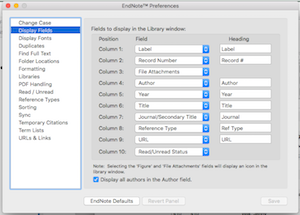
 1. In Preferences – Display Fields, add a Label column. For convenience, I have put this next to the Record Number column as first and second columns.
2. Mark all, or part of, your Endnote library, go to References – Show Selected References.
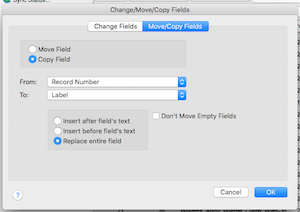
3. Then, chose Tools – Change/Move/Copy Tools, and then Move/Copy Fields. Check for Copy Field, chose From: Record Number To: Label, check Replace entire field (just in case the label column isn’t empty), and OK.
4. Finally, go to Preferences – Temporary Citations and check the box to use Label instead of record numbers as identifier in the citations.
• Furthermore, you can change what sign to use as delimiter in Endnote: go to Preferences – Temporary Citations and Temporary Citation Delimiters and make your choice. I prefer angle brackets like this: <Hedman, 2018 #452>.
Then, make sure that Endnote’s citation delimiters don’t collide with the markup system in Ulysses: go to Preferences – Markup to see what signs are used, and perhaps change one of them so you can have the angle brackets exclusively for intext citations.
 • To add a page number in the intext citation, simply add , p. 32 like this (don’t forget the commas and spaces!): <Hedman, 2018 #452, p. 32>.
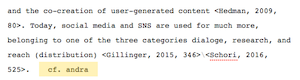
I haven’t found a way to automatically include a prefix or note within the intext citation. Instead I put a temporary note in the text and mark it, so that I know where to put all the e.g. and cf. when I prepare the final manuscript. If you have a valid solution on this, please let me know!
To add several intext citations within the same parenthesis, place a backslash \ (no spaces) between the temporary citations.
Fotnot: Den här texten är på engelska helt enkelt för att de flesta skriver sina akademiska texter på engelska, eller läser engelsk litteratur. Se också Det sköna i den rena texten [170218].
Having learned the markup language of markdown (that’s not difficult at all) and got used to using full screen, black template (this allows me to focus on the text and only the text), my next problem was how to use Ulysses with Endnote, the reference manager provided by my university. For me, it has taken some time to solve all small problems and make things work the way I want them to work. I have of course searched for solutions online, but most suggested solutions does not really solve my problems, as I use several Macs, each with its own installation of Endnote. And while I do sync my Endnote library between these machines (and to an online library that I use on mobile devices), some content does not sync – and this has been a problem. So, here is a guide on how to integrate Endnote (X8) with Ulysses (14.2) that actually works.
• When I write, I use Endnote’s temporary citations to include references in my text. I do this by choosing the right reference from my Endnote library and drag (or copy) it to the right position in my Ulysses sheet. By default my temporary citation has looked like this: {Hedman, 2018 #452}.
 • A major problem, especially when writing a thesis with hundreds of intext citations, is that the record numbers (in this case #452) that are used as default unique identifiers, have not synced. Everything else sync between all my devices, but the record numbers are ”device specific”, so to speak. So while some references share the same record number in all my Endnote libraries, not all do, and this becomes a problem in the next phase of text production – when I export my text to a text manager (Word, in my case) and configure my bibliography (that is, translate the intext citation to the correct (Hedman, 2018) and a post in my list of references. When the unique identifiers don’t line up, all references has to be matched manually to make sure the final manuscript references the correct works.
The way to solve this is to use label instead of record number as the unique identifier in the intext citations. This is the tricky part, and a problem most Ulysses/Endnote-user don’t address when they write manuals on how to integrate Endnote with Ulysses – perhaps because they don’t use several devices. The Label field does sync, so once you’ve set up everything as suggested below, you’ll have no bad surprises when you configure your bibliography. The easiest way to add a unique label to all entries in your Endnote library is to do like this:
 1. In Preferences – Display Fields, add a Label column. For convenience, I have put this next to the Record Number column as first and second columns.
2. Mark all, or part of, your Endnote library, go to References – Show Selected References.
3. Then, chose Tools – Change/Move/Copy Tools, and then Move/Copy Fields. Check for Copy Field, chose From: Record Number To: Label, check Replace entire field (just in case the label column isn’t empty), and OK.
4. Finally, go to Preferences – Temporary Citations and check the box to use Label instead of record numbers as identifier in the citations.
• Furthermore, you can change what sign to use as delimiter in Endnote: go to Preferences – Temporary Citations and Temporary Citation Delimiters and make your choice. I prefer angle brackets like this: <Hedman, 2018 #452>.
Then, make sure that Endnote’s citation delimiters don’t collide with the markup system in Ulysses: go to Preferences – Markup to see what signs are used, and perhaps change one of them so you can have the angle brackets exclusively for intext citations.
 • To add a page number in the intext citation, simply add , p. 32 like this (don’t forget the commas and spaces!): <Hedman, 2018 #452, p. 32>.
I haven’t found a way to automatically include a prefix or note within the intext citation. Instead I put a temporary note in the text and mark it, so that I know where to put all the e.g. and cf. when I prepare the final manuscript. If you have a valid solution on this, please let me know!
To add several intext citations within the same parenthesis, place a backslash \ (no spaces) between the temporary citations.
Fotnot: Den här texten är på engelska helt enkelt för att de flesta skriver sina akademiska texter på engelska, eller läser engelsk litteratur. Se också Det sköna i den rena texten [170218].
25 maj 2018
My presentation on the private side of j-tweeters
Today, at the ICA annual conference i Prague, I presented my latest study on Swedish journalists’ branding practices on Twitter. In this study I focus to what extent journalists include professional and private attributes in their Twitter presentations (bios), and how this has changed over time.
The findings are quite surprising: the share of Swedish j-tweeters that include professional attributes has dropped, though only slightly and from a high level, and the share that include private attributes decreases even more – only a minority include private attributes in their presentations. This is most likely an answer to organizational demands (to be part of an overall organizational branding strategy) and because of the increased level of threats and hate against Swedish journalists.
The study draws from a content analysis of Swedish journalists Twitter presentations (N=2,543 in 2014, and N=2,161 in 2017).
Download (pdf): The private side of journalists. Changing practices in journalists' self-branding on Twitter over time
Axel Bruns is constantly live blogging from the presentations. His summary of my presentation is here: Attributes in Swedish journalists' social media profiles
The findings are quite surprising: the share of Swedish j-tweeters that include professional attributes has dropped, though only slightly and from a high level, and the share that include private attributes decreases even more – only a minority include private attributes in their presentations. This is most likely an answer to organizational demands (to be part of an overall organizational branding strategy) and because of the increased level of threats and hate against Swedish journalists.
The study draws from a content analysis of Swedish journalists Twitter presentations (N=2,543 in 2014, and N=2,161 in 2017).
Download (pdf): The private side of journalists. Changing practices in journalists' self-branding on Twitter over time
Axel Bruns is constantly live blogging from the presentations. His summary of my presentation is here: Attributes in Swedish journalists' social media profiles
18 oktober 2017
Lyssna eller läs – det finns en logik i det också
Min studie om journalisternas varumärkesbyggande och de krockande medielogikerna har blivit journalistik. Lyssna på Therese Rosenvinges reportage i Medierna i P1, där medverkar till exempel också SvD:s Negra Efendic: Krockande logiker när journalister twittrar personligt. Medieormens Cecilia Djurberg har läst hela studien: Svenska journalisters personliga varumärkesbyggande på Twitter undersökt. En kortversion på engelska finns hos Journalism Research News: Journalists’ self-branding on Twitter.
Relaterade inlägg: Ny artikel: Journalister som varumärken i krocken mellan nyhetslogik och sociala medier-logik [171005].
Relaterade inlägg: Ny artikel: Journalister som varumärken i krocken mellan nyhetslogik och sociala medier-logik [171005].
5 oktober 2017
New paper in Journalism on how Twitter and social media logic shape journalists’ self branding
One of my findings may be somewhat surprizing for those interested in international comparative research on social media in journalism. Following previous research on journalists’ self-branding practices on Twitter (Hanusch, 2017), Swedish journalists should be more like their colleagues in UK, prioritizing professional content over personal. However, this study shows that Swedish journalists don’t, most likely due to differences in work environment and organization structures: while the Swedish media market has become increasingly competitive due to structural and economic factors, the work environment is considered as highly individualistic and characterized by horizontal organisation structures.”Journalists are among the most frequent users of Twitter, and Twitter has become an important platform for personal branding. Social media logic promotes not only a chase for vitality and impressive metrics but also a mix of professional, personal, and private content, as well as sharing, interaction, and dialogue. Focusing one aspect of social media logic, the aim of this study is to analyze how the technological affordances of Twitter shape journalists’ self-branding in their account presentations and whether there are differences between groups of journalists. The study draws on a quantitative content analysis of Swedish journalists’ Twitter presentations and account information (N=2,543). The findings suggest that Swedish journalists on Twitter brand themselves as being more audience oriented, networking, and individualistic, projecting a mixed identity including both professional and personal features, and that social media logic influence journalists’ self-branding.”

If you find this interesting and want to read more than the abstract (above), please don’t hesitate to get in touch.
12 november 2016
Busy days in Prague for European media researchers
 |
| Rasmus Kleis Nielsen, the Director of Research at the Reuters Institute for the Study of Journalism at the University of Oxford, giving his keynote on Platforms and publishers: coming to terms with a new digital media environment. |
I also had the opportunity to present my own work in progress on Social media logic in journalism: reshaping the profession. It draws on Swedish journalists’ Twitter account presentations (n=2,543), and shows how social media logic not only determines how journalism can be enacted on Twitter, but also how social media logic shapes hos journalists present themselves and their profession to their followers and peers.
Footnote: Axel Bruns, who chaired ”my” session, has a nice summary of my presentation on Snurblog.
12 mars 2016
New paper in Digital Journalism shows a decline in journalists’ valuation of social media affordances
A new article on social media in journalism, Appropriating social media. The changing uses of social media among journalists across time, co-authored with Monika Djerf-Pierre and Marina Ghersetti, is now published online in Digital Journalism. The article is based on the material we presented at the Future of Journalism conference in Cardiff last September.
The study draws on panel survey data from 2012 and 2014, and for the first time we can now show how individual journalists have changed their use of social media over time: while there is a slight increase in the overall use of social media among journalists, some of the previous ”enthusiasts” in fact decrease their use of social media – or give up social media all together. The findings also suggests a decline in the valuation of social media affordances for different professional tasks. As the abstract says:
The study draws on panel survey data from 2012 and 2014, and for the first time we can now show how individual journalists have changed their use of social media over time: while there is a slight increase in the overall use of social media among journalists, some of the previous ”enthusiasts” in fact decrease their use of social media – or give up social media all together. The findings also suggests a decline in the valuation of social media affordances for different professional tasks. As the abstract says:
”The hype over social media and the rapid expansion of social networking and micro-blogging in recent years can easily lead us to believe that all journalists are online, chatting and tweet- ing, all the time. Previous research, however, indicates that the spread of social media differs between groups of journalists and that social media usage is related to the journalist’s age, gender, type of work and workplace. This paper advances our understanding of how journalists appropriate social media in their professional lives by examining the changes in social media use across time. We examine if and how the perceived usefulness of social media for various professional purposes changes over time, and if different categories of journalists change their usage in different ways. The theoretical perspective draws from theories on the appropriation and adoption of technologies. The empirical material consists of Web survey data collected in 2012 and 2014, targeting representative samples of Swedish journalists. Our findings show that the use of social media increased slightly between the two surveys but the expansion was levelling off in 2014. Some early adopters were abandoning social media, and there was a noticeable decline in the journalists’ valuation of social media affordances.”If you want to read more than the abstract (above), please contact me and I'll send you a link to an ”author's copy”.
7 januari 2016
New paper: Transparency in journalists’ tweets
Yesterday, my article on transparency in journalists’ tweets was published in Social Media + Society, an peer reviewed open access journal.
Transparency is one of the most important norms in journalism, and social media offers new possibilities for transparency on how the news are made, integrating the audiences and letting people get to know the person behind the byline. The study draws from a content analysis of journalists’ tweets, focusing three different – but interrelated – forms of transparency.
Transparency is one of the most important norms in journalism, and social media offers new possibilities for transparency on how the news are made, integrating the audiences and letting people get to know the person behind the byline. The study draws from a content analysis of journalists’ tweets, focusing three different – but interrelated – forms of transparency.
Download (open access): When journalists tweet. Disclosure, participatory, and personal transparency
15 september 2015
My views on #telleveryone: lots of takeaways but I miss one answer
I have reviewed Alfred Hermida’s Tell Everyone: why we share and why it matters for Digital Journalism, and it's now online. In short, I find it to be an ”easy read with lots of takeaways” and insights on the sharing logic of social media, but it does not answer the question of why it matters for journalism.
You can find my review here. If you don’t have access to Digital Journalism please let me know, and I will send you a link to one of my (limited numbers of) free author’s copies.
You can find my review here. If you don’t have access to Digital Journalism please let me know, and I will send you a link to one of my (limited numbers of) free author’s copies.
14 augusti 2015
Another conference, another presentation
This weekend, I am in Copenhagen, Denmark, and the NordMedia 2015 conference. Media and communication researchers from the Nordic countries are gathered to share the latest research in our field. In the journalism division, where I spend most of my session time, there are presentations on the sharing economy in news, data journalism, social media in journalism, professional practices, framing, media economy…
Earlier today, I presented a work in progress as part of a social media in journalism-panel together with Aske Kammer, University of Southern Denmark, and Anders O Larsson, University of Oslo. If you are interested, you can download my presentation via this link:
Work in progress: Patterns of use among Swedish journalists on Twitter (pdf)
Related: Aske Kammer’s NordMedia 2015 in review, in which he summarizes the conference and our social media in journalism panel.
Earlier today, I presented a work in progress as part of a social media in journalism-panel together with Aske Kammer, University of Southern Denmark, and Anders O Larsson, University of Oslo. If you are interested, you can download my presentation via this link:
Work in progress: Patterns of use among Swedish journalists on Twitter (pdf)
Related: Aske Kammer’s NordMedia 2015 in review, in which he summarizes the conference and our social media in journalism panel.
24 maj 2015
My presentation on j-tweeters’ transparency
I’m really enjoying myself at ICA15 in San Juan, Puerto Rico. I’ve listened to many, many interesting panels on journalism research and on social media in journalism. This afternoon, I presented my own research on the Swedish j-tweeters and how transparent they are when they tweet. If you are interested, you can download the presentation via this link (pdf):
When journalists tweet: Disclosure, participatory, and personal transparency (pdf)
When journalists tweet: Disclosure, participatory, and personal transparency (pdf)
11 februari 2015
Reading list for February: 34 papers on social media in journalism
Routledge has put together a list of 34 studies on social media in journalism, open access until end of March. On this list you will find some of the most important international research from some of the best scholars in the field.
One of the articles is The social journalist: Embracing the social media life or creating a new digital divide, by Monika Djerf-Pierre and myself. So, if you are interested in my academic work take the opportunity to read it ;)
Routledge’s list of articles
One of the articles is The social journalist: Embracing the social media life or creating a new digital divide, by Monika Djerf-Pierre and myself. So, if you are interested in my academic work take the opportunity to read it ;)
Routledge’s list of articles
23 maj 2014
My presentation on the j-tweeters
This morning, I presented my research on the Swedish j-tweeters on one of the very first sessions of ICA 2014 in Seattle, WA. If you’re interested, you can download my presentation via this link:
J-tweeters. Pointing towards a new set of professional practices and norms in journalism (pdf)
J-tweeters. Pointing towards a new set of professional practices and norms in journalism (pdf)
10 januari 2014
On ”scettici, pragmatici o attivi”
I must learn Italian. Just look at this:
”La maggior parte dei giornalisti, secondo i risultati della ricerca, sono invece conformisti pragmatici. Questo gruppo è composto da professionisti di diversa età e differente posto di lavoro che utilizzano i social regolarmente, ma in modo molto selettivo. In particolare, i conformisti pragmatici usano Twitter e leggono i blog per cercare informazioni o per sondare l’ambiente, ma postano sui social network raremente.”
It is EJO, European Journalism Observatory, that has written a short piece about mine and Monika Djerf-Pierre’s paper The Social Journalist: Giornalisti sui social: scettici, pragmatici o attivi. There is also a version in English: Who Tweets Most? Journalists and Social Media.
Though I don't understand Italian, I prefer the Italian version. Just because it looks so beautiful!
17 december 2013
Gaykultur, homopropaganda och referrer spam (Gay culture, homosexual propaganda and spam)
 |
| Ett exempel på homopropaganda. |
Eller ja, det är nog inte så att jag har någon enda läsare i varken Ryssland eller Ukraina.
Däremot har bloggen drabbats av såväl referrer spam som comment spam.
Referrer spam ser ut som om en webbplats länkar till dig, men det gör den inte. Det man hoppas på är att få en länk tillbaka (t ex eftersom många automatiskt publicerar listor på "länkande webbplatser") och därigenom ranka lite högre hos exempelvis Google. Alltså en slags sökmotoroptimering. Ibland innehåller länken virus.
Comment spam är kommentarer som väl är tänkta att se allmänt uppskattande ut ("oj, vilket intressant blogginlägg") och som innehåller en länk. Också här hoppas man på publicering och klick på den här länken, också här handlar det om sökmotoroptimering eller att sprida virus.
Såväl referrer spam som comment spam är lite som fotsvamp – svårt att helt bli av med när man väl drabbats. Som läsare ser ni varken eller, eftersom jag inte publicerar "länkande webbplatser" och förhandsmodererar alla kommentarer.
Men jag kan inte låta bli att retas lite med de som står bakom, om någon nu skulle få för sig att faktiskt besöka min blogg.
* * *
In English: This blog is currently sent a lot of referrer spam and comment spam, mostly originating from Russia and Ukraine. I can't do much about the spam – except from not publishing it, of course. But I can warn my spammers and potential readers in Russia and Ukraine that this blog contains a lot of gay culture as well as homosexual propaganda.
29 juli 2013
On skeptics, conformists and activists
Researchers at the university in Galway, Ireland, has recently launched a national online survey with questions on how, why and in what way Irish journalists use social media. The questions correspond rather well to those in the latest Swedish Journalist Survey that Monika Djerf-Pierre and myself wrote an articel on (The Social Journalist, published in Digital Journalism), and I'm really looking forward to be able to compare the results.
An educated guess is that the Irish researchers will find some similar patterns among the Irish journalists as those we found among the Swedish, for example substantial differences in the use and level of usage among different social groups of journalists. Furthermore, the media in Ireland are in many respects not comparable with the media in Sweden, and therefore the patterns of social media use may be different for example when it comes to the degree of private vs. professional use.
You can read more about the Irish survey (and about Irish research on journalism) at the blog Digital Humanities & Journalism.
On the blog, the researcher Marie Boran has written a nice review of our article, headed Skeptics, Conformists and Activists: How and Why Journalists Use Social Media. This review provides a very good summery of our article, and I'm really flattered that someone has taken the time to do such a thorough reading!
An educated guess is that the Irish researchers will find some similar patterns among the Irish journalists as those we found among the Swedish, for example substantial differences in the use and level of usage among different social groups of journalists. Furthermore, the media in Ireland are in many respects not comparable with the media in Sweden, and therefore the patterns of social media use may be different for example when it comes to the degree of private vs. professional use.
You can read more about the Irish survey (and about Irish research on journalism) at the blog Digital Humanities & Journalism.
On the blog, the researcher Marie Boran has written a nice review of our article, headed Skeptics, Conformists and Activists: How and Why Journalists Use Social Media. This review provides a very good summery of our article, and I'm really flattered that someone has taken the time to do such a thorough reading!
24 juni 2013
The Swedish national public service radio's
handbook on social media for journalists
Last spring, the Swedish national public service radio, SR, published an excellent handbook on social media for journalists in both Swedish and English.
The handbook discusses the strategics of why news organizations should be active in social media, and then focuses on the three strategical areas of dialogue, research and distribution of content. It also discusses some ethical dilemmas and legal issues, along with a section of private vs. professional use.
The handbook is available for free, as a pdf-file for download. You'll find it here. I highly recommend it!
On June, 21, Monika Djerf-Pierre and I presented our paper The social journalist at ICA 2013 in London. You'll find the slides (pdf) here).
The handbook discusses the strategics of why news organizations should be active in social media, and then focuses on the three strategical areas of dialogue, research and distribution of content. It also discusses some ethical dilemmas and legal issues, along with a section of private vs. professional use.
The handbook is available for free, as a pdf-file for download. You'll find it here. I highly recommend it!
On June, 21, Monika Djerf-Pierre and I presented our paper The social journalist at ICA 2013 in London. You'll find the slides (pdf) here).
Prenumerera på:
Inlägg (Atom)